
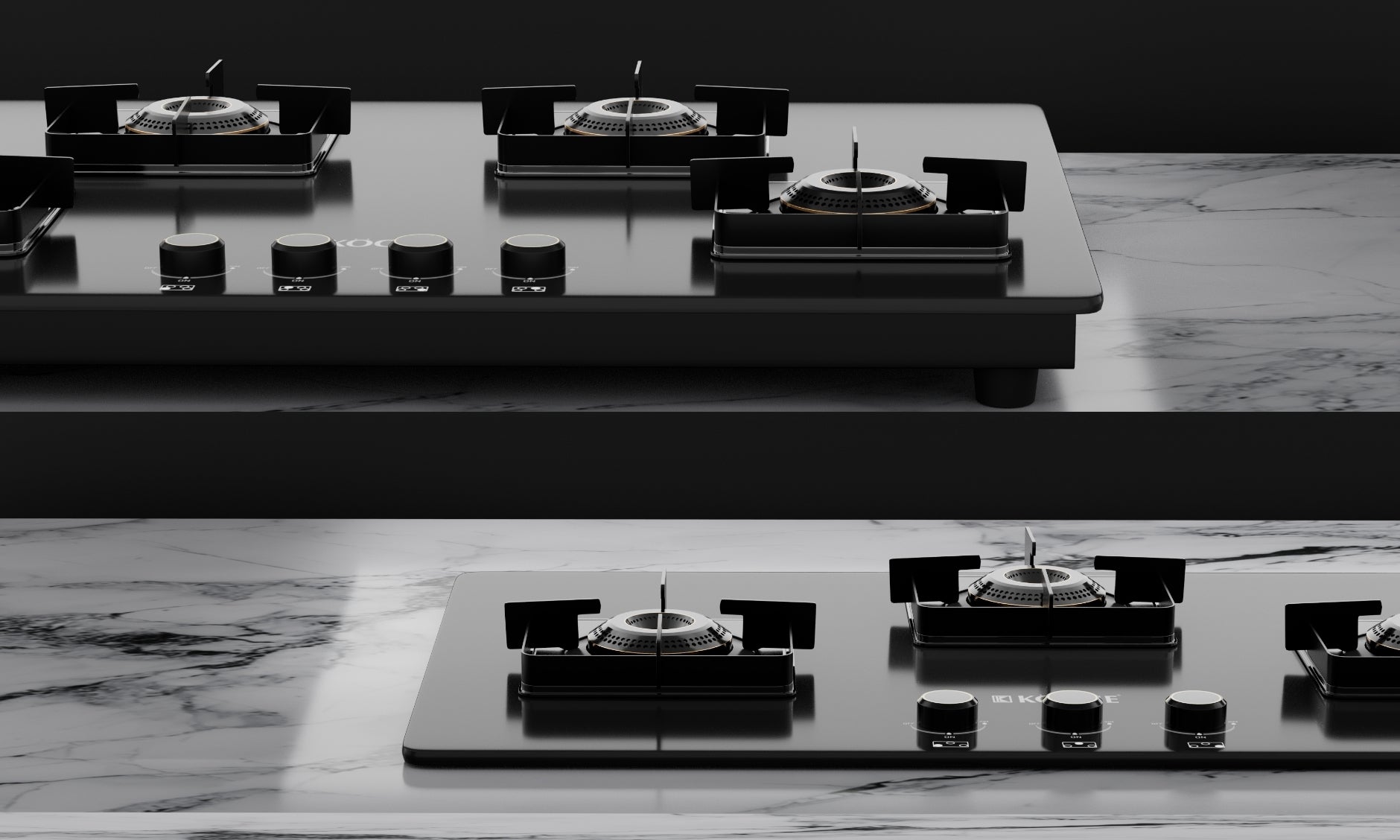
The past decade has brought modern evolution to the functionality and aesthetics of most new kitchens. One of the most common dilemmas faced by new homeowners is whether to invest in a gas stove or a built-in hob. While both appliances are designed to enable the customer to achieve the same basic end—the heating of food—the differences in design, methods of installation, longevity, and overall consumer experiences are vast.
Knowing the difference between a hob and a gas stove is critical before making a purchasing decision. These differences are important to know when you are about to renovate your kitchen, as they help you choose the option that best suits your cooking habits, available space, and design preferences. Köche offers impeccable 4-burner hobs and gas stoves designed for modern kitchens and an unmatched cooking experience.
What is a gas stove?

Before we engage in a comparison, it is important to first comprehend what a gas stove is. A gas stove is a type of cooking appliance that is designed to stand alone and uses LPG or PNG for fuel. The appliance features several burners mounted on a metal chassis, with operational control knobs on the front. Gas stoves are convenient to use and set up, and they are widely found across Indian homes. They are available as 2-burner, 3-burner, and 4-burner models, and require no slab cutting as they sit on the kitchen counter.
Gas stoves are popular for the following reasons:
-
Low cost
-
Low effort upkeep
-
Simple gas stove installation
-
Mobility
Gas stoves' high utility and low cost keep them in demand.
What is a Hob?


Next, let's look at what a hob is. Hobs are also known as built-in hobs. These are contemporary cooking devices designed to be mounted within the kitchen counter. Unlike traditional countertop stoves, hobs sit flush with the countertop for a streamlined, finished look in the kitchen.
Most hobs are made of tempered glass and/or stainless steel. These materials, in conjunction, allow for concealed gas lines to be mounted below the counter.
Some features of hobs include:
- Stylish and modern look
- Auto ignition
- Premium Brass burners
- User and environmental safety
Due to these design reasons, hob installation requires a designer and a contractor.
Difference Between Hob and Gas Stove
Distinguishing the difference between a hob and a gas stove means examining several factors:
1. Design & Aesthetics
The most apparent difference lies in design.
-
A gas stove sits above the counter and is visible as an individual unit.
-
A hob is integrated within the countertop, allowing for a smooth and modern design.
If visual design and a contemporary kitchen look are important, countless consumers choose the hob vs gas stove option that improves their interior design.
2. Installation Process
The two options take different approaches.
-
Gas stove installation is as simple as connecting the regulator and gas line.
-
Hob installation is more complicated because it involves cutting the granite or countertop to accommodate the unit.
For this reason, hob installations are usually more expensive and require a specialist.
3. Cleaning & Maintenance
In the hob vs gas stove battle, cleaning and maintenance are also important considerations.
-
Gas stoves tend to be more difficult to clean because the unit is elevated, and cooking spills can easily get underneath it. Cleaning the area under the stove is a challenge.
-
Because hobs are flush-mounted, they stop food debris from falling underneath the unit.
On the other hand, hob maintenance is often done by professionals, especially when there are issues with the internals.
4. Safety Features
Modern hobs implement new safety elements, such as:
-
Detecting flame failure
-
Auto ignition
-
Glass that is resistant to heat and is tough
These features may or may not be included in older gas stove designs. Premium models include auto-ignition but do not feature flame detection as standard hobs do.
5. Cost Comparison
Costs play an important part in the decision.
-
For the majority, gas stoves are the most economical.
-
Because of expensive technology, quality integration, and the need for an installation, hobs tend to be more expensive.
With the hob vs gas stove considerations, finances are a determining factor.
6. Durability & Build Quality
-
Hobs are constructed from toughened glass with quality brass burners that are made to last.
-
Gas stoves can be made with the same durability. However, when not kept clean, the exposed components may be more susceptible to damage.
Both types can last for many years if taken care of, but hobs may offer better durability for corrosion and staining.
7. Space Utilisation
Space is a vital consideration for all kitchens, especially smaller ones.
-
Hobs fit into modular kitchens as part of the cabinetry, creating a streamlined look and making the storage compartment underneath the cabinets much easier to organise.
-
In contrast, a gas stove takes up a portion of the countertop and can reduce the amount of storage available underneath.
Therefore, in many modular designs, users tend to prefer the hob vs gas stove option that integrates well with the cabinetry.
8. Performance & Efficiency
From a functional standpoint, both appliances deliver similar cooking performance when burner quality is comparable.
-
Modern hobs often include multi-ring burners that distribute flame evenly, improving cooking efficiency for Indian recipes requiring high heat.
-
Gas stoves also provide efficient heating, especially models with brass burners.
Ultimately, performance differences depend more on model specifications than on whether it is a hob or a stove.
Quick Comparison between a Hob and a Gas Stove?
|
Feature |
Hob |
Gas Stove |
|
Design & Aesthetics |
Built into the countertop for a sleek, modern modular kitchen look |
Sits above the countertop as a separate appliance |
|
Installation |
Requires cutting the countertop and professional installation |
Simple installation by connecting the gas line and regulator |
|
Cleaning & Maintenance |
Easier to clean due to flush design and smooth glass surface |
Harder to clean as food can fall underneath the stove |
|
Safety Features |
Often includes auto-ignition, flame failure detection, and heat-resistant glass |
Basic models may lack advanced safety features; premium models include auto-ignition |
|
Cost |
Generally more expensive due to design, materials, and installation |
More affordable and widely available |
|
Durability |
Usually made with toughened glass and brass burners, resistant to corrosion and stains |
Durable but exposed parts may wear faster if not maintained |
|
Space Utilisation |
Better for modular kitchens, integrated design saves countertop space |
Occupies countertop space and may reduce storage options |
|
Performance & Efficiency |
Often includes multi-ring burners for even heat distribution |
Provides similar cooking performance, especially with brass burners |
Quick Summary:
-
Choose Hob if you want modern design, easier cleaning, and modular kitchen integration.
-
Choose Gas Stove if you prefer affordability, simple installation, and easy replacement.
Koche Hob: A Modern Kitchen Upgrade
The Köche Betty 4 burner hob is a premium hob option that is one of the best when it comes to functionality and design. It is meant for modern modular kitchens and comes with a toughened glass top, premium Indian brass burners, and multi-pin flame distribution.
The brand’s priority is safety, durability, and user-friendliness. The Köche Betty hob, boasting sleek design features and auto ignition, caters to homes that want to step up their cooking game. The design is engineered to meet emerging trends in kitchens that simplify and offer quick functional solutions, providing an ideal upgrade option for homeowners replacing their old gas stove.
Up-to-Date Kitchen Gadgets
The most recent market research shows demand for integrated kitchen appliances in urban areas to be ever-increasing. With more modular kitchens being installed, hobs are now common in urban areas.
Such trends are attributed to the following factors:
-
More disposable income
-
Demand for designer kitchens
-
Preference for integrated designs
-
Increased safety awareness
In developing semi-urban and rural areas markets, gas stoves remain the market leaders due to their low-cost and simplified replacement.
This emerging trend illustrates that both types remain valid in the debate of the difference between a hob and a gas stove.
Summary of Pros and Cons
Gas Stove: Pros
-
More affordable
-
Great for relocation
-
Installation is easier
-
Less maintenance
Gas Stove: Cons
-
Design is less appealing
-
More cleaning
-
Fewer safety features
Hobs: Pros
-
Design is more appealing
-
Takes up less space
-
More safety features
-
Easier to clean
Hobs: Cons
-
Higher price
-
Installation is more difficult
-
Less relocation flexibility
Our Recommendation
The choice between a hob vs a gas stove is based on:
-
Overall budget
-
Design preference
-
How often you cook
-
How much maintenance do you want to do
If you want to build a more modern-looking kitchen unit, a hob will help you do that. But if you want a more flexible and reasonable option, a gas stove will help you do that. A hob is the more modern option, whereas a gas stove is the more flexible option.
Also Read: BLDC Chimney vs Conventional Chimney: Which One Should You Buy in 2026
Conclusion
Comprehending the difference between a hob and a gas stove allows homeowners to make choices according to their kitchen space and the way they like to cook. While a gas stove brings affordability, portability, and simple gas stove installation, a hob offers a modern, integrated look with additional convenience and elaborate hob installation. Although both devices serve the same primary purpose, they are different in terms of design, price, and ease of use.
As modular kitchens become increasingly popular, the debate around hob vs gas stove continues to evolve. Ultimately, whether you choose a traditional stove or a premium hob like the Köche 4 burner hob, the best option is one that balances efficiency, safety, and aesthetics for your household's needs.
FAQ's
Q1. Is a hob safer than a traditional gas stove?
Ans: Many modern hobs come with advanced safety features such as flame failure protection and auto-ignition systems. While traditional gas stoves are safe when used properly, hobs generally offer additional built-in safety mechanisms, making them a preferred option in modular kitchens.
Q2. Does hob installation require changes to the kitchen structure?
Ans: Yes, hob installation requires a cut-out in the countertop to fit the appliance flush with the surface. This process must be done accurately by professionals. In contrast, gas stove installation simply involves placing the stove on the counter and connecting it to the gas supply.
Q3. Which is easier to clean: hob or gas stove?
Ans: A hob is usually easier to clean because it sits flush with the counter and prevents spills from going underneath. Gas stoves may require lifting the unit to clean the area beneath, especially after heavy cooking.
Q4. Are hobs more expensive than gas stoves?
Ans: Generally, hobs are more expensive due to their built-in design, advanced burners, and safety features. Gas stoves are more budget-friendly and widely available, making them suitable for cost-conscious buyers.
Q5. Can I replace a gas stove with a hob in an existing kitchen?
Ans: Yes, but switching from a gas stove to a hob requires countertop modification for proper fitting. Professional assessment is recommended to ensure safe and accurate installation without damaging the kitchen structure.
Share:
Which Type of Cooktop Is Most Energy-Efficient for Home Use?
Pros and Cons of Using a Filterless Kitchen Chimney