
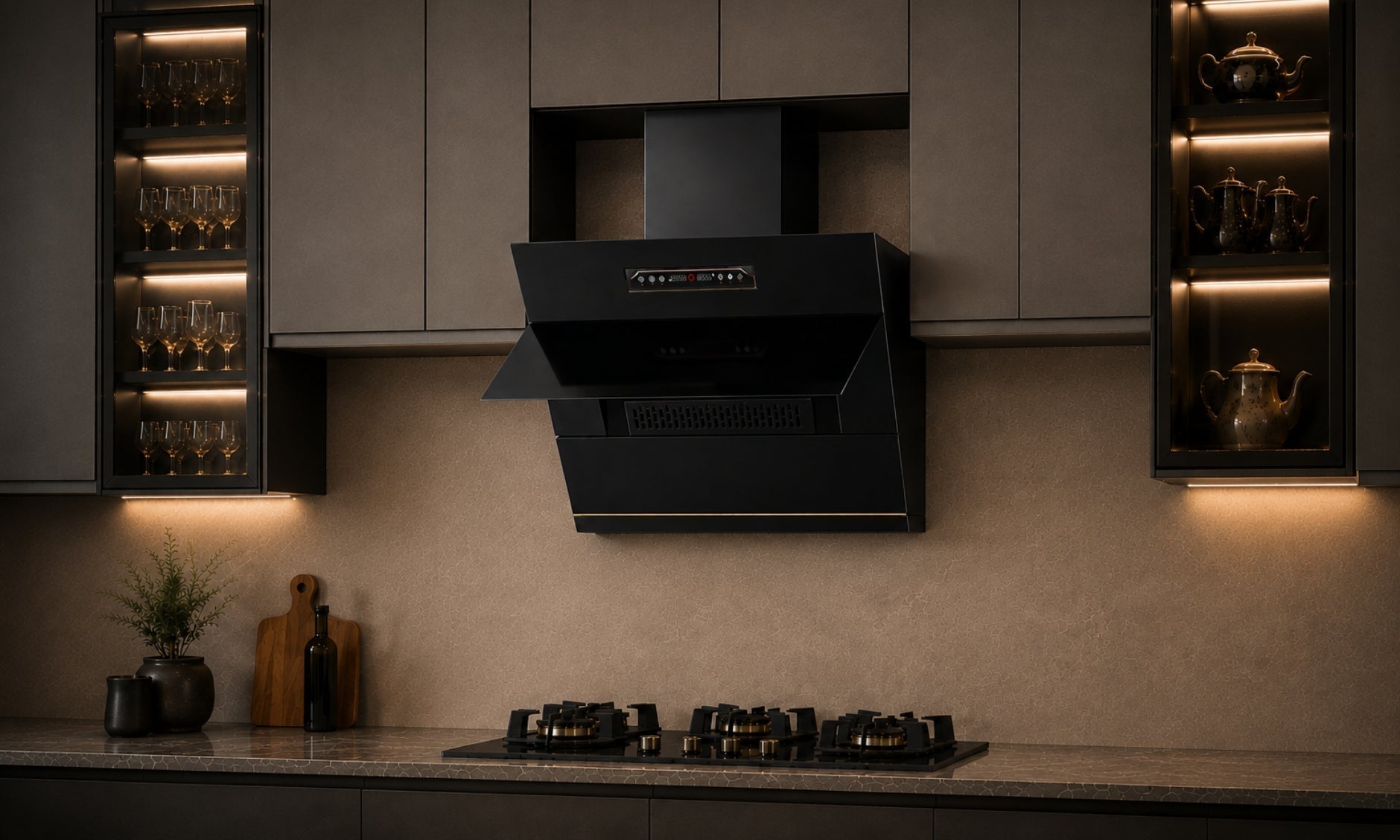
Most people shopping for a kitchen chimney focus on brand, price, and colour, and only think about size once the electrician is standing in the kitchen. Getting the size right affects how effectively the chimney captures smoke, oil, and steam. This guide focuses on hob width, suction power, ducting, ceiling height, kitchen layout, and the other buying factors that support the right chimney choice.
Why Chimney Size Actually Matters
A chimney that's too small for your hob leaves the outer burners uncovered, so smoke from those burners escapes into the room instead of being pulled up. A chimney that's oversized wastes wall space, costs more, and doesn't necessarily perform better if the suction power isn't matched to your kitchen's volume and cooking style.
In short, size is about coverage, and suction power (measured in m³/hr or CMH) is about how fast that coverage actually clears the air. You need both to be right.
Step 1: Match the Chimney Width to Your Hob
This is the easiest rule to remember, and the one most people get wrong.
| Hob Width | Recommended Chimney Size |
|---|---|
| 2-burner hob (approx. 50 to 60 cm) | 60 cm chimney |
| 3 to 4 burner hob (approx. 60 to 75 cm) | 75 cm chimney |
| 4-burner or broader cooking counters (75 to 90 cm) | 90 cm chimney |
If your hob is 75 cm and you install a 60 cm chimney, the outer burners sit outside the suction zone. Smoke from those burners will curl into the room no matter how powerful the motor is. When in doubt, size up rather than down.

Step 2: Calculate the Suction Power Your Kitchen Needs
Chimney width tells you where the suction happens. Suction power (CMH, cubic metres per hour) tells you how much air actually gets pulled and expelled. This is where most low-cost chimneys quietly fall short.
A simple formula used across the industry:
For example, a kitchen measuring 3m × 3m × 3m has a volume of 27 m³. At 10 to 15 air changes per hour, you would want a chimney rated somewhere between 1200 and 1400+ m³/hr.
As a general rule of thumb for Indian kitchens:
- Light, occasional cooking, open kitchen layout: 1000 to 1200 m³/hr is workable
- Regular Indian cooking (tempering, frying, daily use): 1200 to 1500 m³/hr
- Heavy cooking, deep frying, tandoor-style, non-vegetarian, closed kitchens: 1500 m³/hr and above
Indian cooking involves a lot more oil, spice, and high-heat frying than most international kitchens, which is exactly why chimneys imported with international suction ratings often underperform here. Always size up rather than settle for the minimum.
Step 3: Ducted or Ductless Changes Your Size Math Too
Ducted chimneys vent smoke outside through ducting on an exterior wall. They are more efficient, but a long or bent duct run reduces effective suction. Every 90 degree bend can cost you noticeable CMH. If your duct run is long, factor in a chimney with headroom above your calculated requirement.
Ductless or recirculating chimneys filter air and release it back into the kitchen through carbon filters. These are ideal for interior kitchens with no external wall access, but they need a slightly higher rated suction to compensate for filtration resistance, and the filters need more frequent attention.

Step 4: Ceiling Height and Kitchen Layout
Two kitchens with the same floor area can need very different chimneys if their ceiling heights differ. Taller ceilings mean more air volume to clear, so the CMH calculation above should always use your actual ceiling height, not an assumed standard.
Open-plan kitchens that flow into a living or dining area also need more suction power than a closed, compact kitchen, since smoke has a larger volume to disperse into before the chimney can pull it back.
A Quick Sizing Checklist
- Chimney width is equal to or greater than hob width, ideally with 5 to 10 cm overhang on each side
- Suction power calculated from actual kitchen volume, not guesswork
- Extra CMH headroom added for heavy or oily Indian cooking
- Ducted vs ductless suitability checked against your kitchen's wall access
- Duct length and bends accounted for, if ducted
Sizing It Right, the Köche Way
Every Köche BLDC chimney is available across 60 cm, 75 cm, and 90 cm widths, with suction ratings from 1400 to 1650 m³/hr, so there is a size-to-power match for compact kitchens as well as larger, open cooking spaces. The BLDC motor also means you get stronger suction at lower noise and power draw than a conventional AC motor chimney of the same size, so sizing up for better performance does not mean sizing up on your electricity bill or the noise it makes while running.
If you are unsure which width or suction rating fits your kitchen, measure your hob width and rough kitchen dimensions before you shop. It takes two minutes and saves you from buying a chimney that looks right but does not actually clear the air.
Frequently Asked Questions
1. What size chimney do I need for a 60 cm hob?
A 60 cm chimney is the minimum matching width. A wider model can provide additional coverage if the installation space allows it.
2. Is a bigger chimney always better?
Not necessarily. Match width to the hob and suction to the kitchen and cooking requirements.
3. What suction power is ideal for Indian kitchens?
The Köche guide positions 1200–1500 m³/hr for regular Indian cooking, with 1500 m³/hr and above for heavier cooking or larger open kitchens.
4. Does ceiling height affect chimney sizing?
Yes. Taller ceilings increase air volume, so actual room height should be included when estimating requirements.
5. Should I choose ducted or ductless?
Choose according to installation access. Ducted systems vent outside and are generally more effective for extraction; ductless systems recirculate filtered air.
6. Can I install a 90 cm chimney over a 60 cm hob?
Yes, provided the installation space and design allow it. It is not required if a correctly sized 60 or 75 cm chimney already provides suitable coverage.
7. How do I know if my chimney is undersized?
Smoke escaping near outer burners or persistent greasy residue can indicate insufficient coverage or suction.
Conclusion
Choosing the right chimney size starts with hob width, but it should not stop there. Kitchen volume, cooking style, ducting, ceiling height, filter requirements, and noise all affect the final choice. Match the width first, then choose enough suction capacity for the way the kitchen is actually used.
Share:
Ultimate Guide: Choosing the Right Kitchen Chimney in 2026
How to Install a Ductless Chimney in Your Kitchen: Step-by-Step Guide