
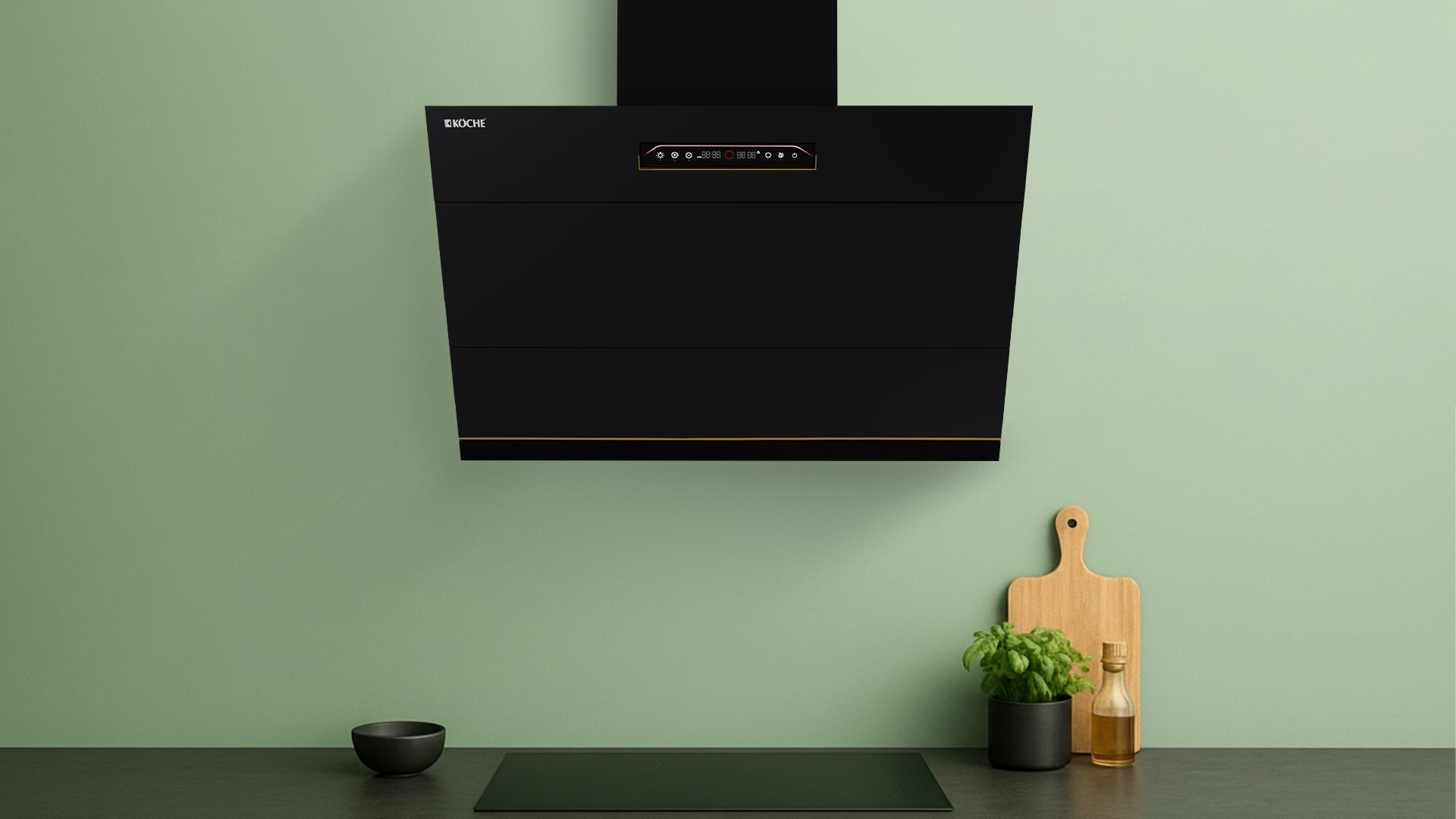
Indian cooking brings bold, layered flavors to every home, but it also puts real pressure on kitchen ventilation. Heavy use of spices, oils, and high-heat techniques generate far more smoke and odor than typical Western cooking. Picking the right chimney and the right motor technology inside it, is what keeps a kitchen fresh without compromising how you actually cook. This guide walks through what to look for while choosing a chimney for your kitchen in 2026.
✓Match chimney width to your cooktop size :60 / 75 / 90 cm.
✓Aim for at least 1200 m³/hr suction for everyday Indian cooking.
✓BLDC motors run quieter, use less power, and last longer than AC motors.
✓Ducted = stronger performance. Ductless = easier install, no core cutting.
Understanding Indian Cooking Challenges and Chimney Requirements
Indian kitchens face ventilation demands that most standard exhaust systems weren't designed for. Tempering spices in hot oil produces sudden, intense bursts of smoke. Deep frying, tandoor-style cooking, and pressure cooking add heavy steam and heat on top of that, often at temperatures higher than typical Western stovetop cooking. Grinding and roasting spices release strong aromatic particles that spread through the house fast if extraction is weak. Indian households also typically cook more often through the day than Western households do, so the exhaust system needs to perform consistently across multiple sessions, not just once. This is why motor durability and easy grease management matter as much as raw suction.
Important Features to Consider When Choosing the Right Kitchen Chimney:
1. Choosing the Right Chimney Size
One of the most important decisions when buying a kitchen chimney is choosing the right size. If you have a 4-burner cooktop but install a 60 cm chimney, a lot of the smoke and fumes can escape from the sides instead of being captured effectively. As a general rule, your chimney should be the same width as or wider than your cooktop.
| Size | Best For |
|---|---|
| 60 cm | Best for most 2-burner cooktops. |
| 75 cm | Ideal for most 3-burner cooktops and many compact 4-burner cooktops. |
| 90 cm | Recommended for most 4 and 5-burner cooktops. |
2. Suction Power Requirements
Indian cooking involves frequent frying, tadkas, grilling, and high-heat cooking, so choosing a chimney with at least 1200 m³/hr suction power is recommended.
| Suction | Best For |
|---|---|
| 1200 m³/hr | Ideal for small to medium kitchens and everyday Indian cooking. |
| 1500 m³/hr | Best for medium to large kitchens with frequent heavy cooking. |
| 1600+ m³/hr | Recommended for large or open kitchens and intensive cooking. |
You'll also benefit from high suction power if:
- Your kitchen is large or open.
- The duct pipe used is 6 feet or more (around 2 metres).
- The duct has multiple bends.
3. Types of Chimneys
Choosing the right type of kitchen chimney depends on your kitchen layout

Wall Mounted
The most common type of kitchen chimney. Installed against a wall directly above the stove or hob, making it ideal for kitchens where the stove is placed along a wall.

Island
Designed for kitchens with an island counter where the cooktop is located in the center of the kitchen. These chimneys are suspended from the ceiling.

Built-in
Installed inside an overhead kitchen cabinet, leaving only the hood visible. A great choice for homeowners who want a minimal look.

Corner
Designed for cooktops installed in the corner of the kitchen. These are less common and are mainly used in kitchens with corner layouts where a standard wall-mounted chimney cannot be installed.
4. Motor Technology: BLDC vs Conventional AC
Conventional AC motors tend to become noisier as suction power increases and wear out faster with everyday use. Köche's advanced resin-concealed BLDC motors eliminate this trade-off, delivering up to 40% lower power consumption, up to 40% less noise, and up to twice the lifespan of conventional AC motors.
That's why every Köche chimney is powered by BLDC technology. While a BLDC chimney may have a slightly higher upfront cost, the long-term savings on electricity and its longer motor life make it a smarter investment over time.
Figure below: BLDC Motor Used in a Kitchen Chimney

5. Ventilation Type: Ducted or Ductless
This is one of the most debated questions when buying a kitchen chimney.
A ducted chimney uses a duct pipe to vent smoke, grease, odours, and heat completely outside your home. A ductless chimney uses charcoal filters to trap grease, smoke particles and odours before recirculating the cleaned air back into the kitchen. In general, a ducted chimney offers better overall performance. However, if you live in a rented apartment or can't make a wall opening for ducting, a ductless chimney is the better choice.
Choose Ducted if:

- There's high oil usage
- Your kitchen has limited natural ventilation
- Your kitchen gets hot while cooking
- You can install a duct pipe and make a wall opening (core cutting).
- You want maximum smoke and heat removal with minimal filter maintenance.
Choose Ductless if:

- You cook with less oil and generate less smoke.
- Your kitchen has good ventilation or an exhaust fan
- Core cutting or duct installation isn't possible (ideal for rented homes).
- You want a quick, hassle-free installation.
6. Filter Technology
Both Baffle Filter and Filterless chimneys work well for Indian cooking. The main difference lies in how they separate grease from smoke. While both are effective, Filterless chimneys require significantly less maintenance since there are no physical filters to clean.
Baffle Filter
- Uses multiple curved stainless steel panels that force smoke to change direction. This helps to separate oil and grease from the smoke.
- The filters need to be cleaned periodically to maintain optimal performance.
Filterless
- Has no physical filters in the airflow path. Instead, it uses powerful airflow and centrifugal force to separate grease and oil from the smoke.
- With no physical filters to clean, maintenance is significantly lower and there's no need for frequent scrubbing.
7. Auto-Clean Technology
Heat Auto Clean uses a built-in heating element to melt the grease accumulated inside the chimney. During a 10-minute Heat Auto Clean cycle, the grease melts and flows into the oil collector tray. Once the cycle is complete, all you need to do is remove, clean, and reinstall the oil collector tray.
8. Controls
Traditional push-button chimneys are still available, but touch and gesture controls have become the preferred choice for modern Indian kitchens due to their convenience, ease of use, and premium look.
Gesture Control lets you operate the chimney with a simple wave of your hand. It's especially useful when your hands are oily or wet, allowing you to turn the chimney on or off or adjust the suction speed without touching the panel.
Touch Control offers precise and responsive operation through a sleek touch panel. With a simple tap, you can control the fan speed, lighting, and features like Heat Auto Clean, giving you complete control at your fingertips.

9. Warranty and After-Sales Support
Last but not least, warranty and reliable after-sales service are just as important as the chimney itself.
Köche chimneys come with a 12-year motor warranty and a 2-year comprehensive product warranty. With a nationwide service network, installation and service are typically provided within 1–5 days, depending on your location.
Step-by-Step Chimney Selection Process
Step 1: Before You Buy, Measure Your Kitchen
Make sure the chimney will fit your kitchen by checking these dimensions:
1. Available Width
- If you have overhead cabinets, measure the space between them.
- Check the product dimensions provided by the manufacturer or seller.
- Ensure the available width is at least 2 cm wider than the width of the chimney.
2. Distance Between the Cooktop and Chimney
Maintaining the correct installation height is essential for efficient smoke extraction and safe operation.
- Check the product dimensions provided by the manufacturer or seller.
- Ensure there's enough vertical space to accommodate the chimney while maintaining the recommended distance between the chimney and the cooktop.
- For T-shaped, curved, and cube shaped chimneys: The ideal distance is 70-75 cm from the cooktop.
- For Slant chimneys: The ideal distance is 40-45 cm from the cooktop.
Step 2: Select the Right Chimney Size
Choose the chimney size based on the width and number of burners on your cooktop.
| Chimney Size | Recommended For |
|---|---|
| 60 cm | Best for most 2-burner cooktops |
| 75 cm | Best for most 3-burner and compact 4-burner cooktops |
| 90 cm | Recommended for most 4 and 5-burner cooktops. |
Step 3: Choose the Right Suction Capacity
| Suction | Best For |
|---|---|
| Less than 1200 m3/hr | Ideal for light cooking like boiling, steaming |
| 1200 m³/hr | Ideal for small to medium kitchens and everyday Indian cooking. |
| 1500 m³/hr | Best for medium to large kitchens with frequent heavy cooking. |
| 1600+ m³/hr | Recommended for large or open kitchens and intensive cooking. |
Step 4: Select the Chimney Type and Ventilation
Choose the chimney type based on your kitchen layout:
Wall-Mounted Chimney
Ideal for kitchens where the cooktop is placed against a wall.
Island Chimney
Ideal for kitchens with an island cooktop in the center of the room.
Built-in Chimney
Ideal for modular kitchens with overhead cabinets and a concealed design.
Corner Chimney
Ideal for kitchens where the cooktop is installed in a corner.
Ducted
Ideal for homes where ducting and core cutting are possible, offering the best smoke and heat removal
Ductless
Ideal for rented homes or kitchens where ducting isn't possible, requiring no core cutting or duct installation.
Step 5: Choose the Features That Matter
Want less maintenance?
Choose a filterless chimney with Heat Auto Clean.
Want lower power bills and less noise?
Choose a BLDC chimney.
Want hands-free convenience while cooking?
Choose a chimney with Gesture Control.
Need maximum smoke extraction?
Choose a chimney with high suction power and multi-directional suction (ideal for large cooktops) like Bravo 90.
Köche chimneys feature filterless technology, Heat Auto Clean, 9+1 turbo speed, and gesture and touch controls.
Step 6: Set Your Budget
Finally, allocate budget considering the chimney upfront cost, installation, warranties and long-term maintenance. While BLDC chimneys have a higher upfront cost, they consume less electricity, run quieter, and last longer, making them a better long-term investment.
Refer to the comparison table below to explore Köche's chimney range and pricing.
Explore Köche's Chimney Range
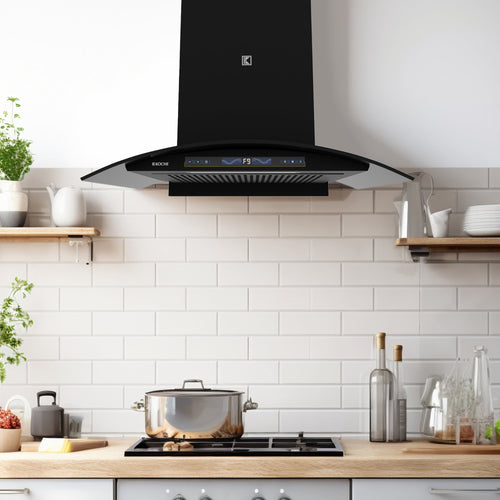
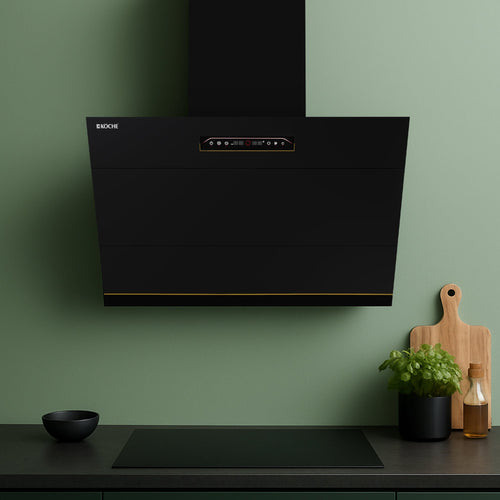
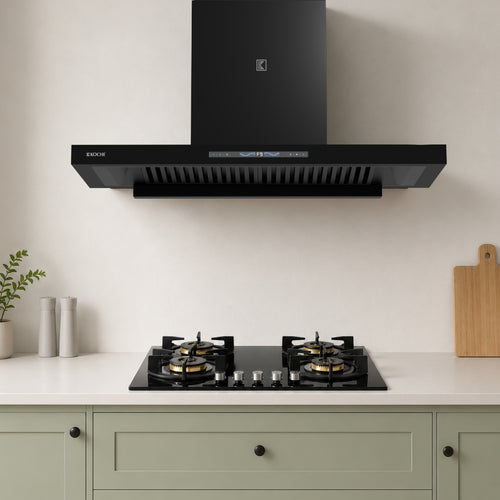
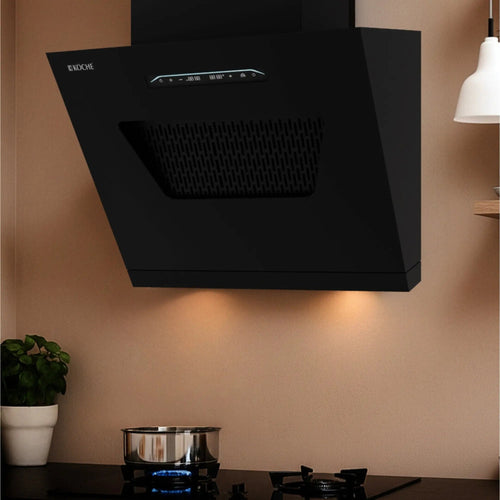
Köche Chimney Range — Full Comparison
| Model | Size(s) | Suction | Design | Ventilation | Standout Feature | Price |
|---|---|---|---|---|---|---|
| Enzo | 1450 m³/hr | Curved glass, gold accents | Ducted | Sleek curved profile | ₹16,490 | |
| Laura | 1650 m³/hr | Slant, gold detailing | Ducted | Hydraulic louvers, touch panel | ₹21,990 | |
| Stark | 1500 m³/hr | T-shaped | Ducted | Filter-less T-shape design | ₹19,490 | |
| Pronto | 60 cm | 1450 m³/hr | Slant modular | Ducted | Built for 2–4 burner stoves | ₹15,990 |
| Bravo 90 | 90 cm | 1650 m³/hr | L-shaped | Ducted | 3-way Multi-Suction Technology | ₹31,990 |
| Port 60 | 60 cm | 1400 m³/hr | Compact portable | Ductless (Plug & Play) | No ducting or core-cutting needed | ₹12,990 |
Installation Guide and Placement Tips
Recommended Height from the Cooktop:
Maintain a distance of 70–75 cm from the cooktop for T-shaped, curved, cube shaped chimneys.
Slant chimneys: Maintain a distance of 40–45 cm from the cooktop.
Ducting: Keep the duct pipe as short and straight as possible to maintain strong suction and reduce noise.
Tiled or Window Installations: Chimneys can be installed on tiled walls with proper care to avoid tile damage. Window installations are also possible, provided there is adequate structural support.
Professional Installation: Ducted chimneys require core cutting and duct installation, making them more complex to install. Ductless chimneys are much easier to install, typically requiring only a mounting bracket and two drill holes. It's easy to do by yourself. However, professional installation is recommended for both to ensure safe installation, optimal performance and warranty compliance.
Maintenance for Long-Term Performance
- Regular cleaning: Wipe the exterior regularly using a soft cloth, lukewarm water, and a mild detergent. Avoid abrasive scrubbers or harsh chemicals, as they can damage the finish.
- Using Heat Auto Clean: To start the 10-minute Heat Auto Clean cycle, press and hold the Heat Auto Clean button for 3 seconds while the chimney is at Speed 0 (standby mode). Once the cycle is complete, remove, empty, and clean the oil collector tray.
- Scheduled servicing: We recommend servicing your chimney twice a year to maintain optimal suction performance and extend its lifespan. If you notice reduced suction, unusual noise, or any other performance issues, it's best to have your chimney inspected by a qualified technician.
Frequently Asked Questions
Do you need a kitchen chimney, or is an exhaust fan enough?
An exhaust fan helps remove smoke only after it has already spread throughout the kitchen and does not filter grease.
A kitchen chimney captures smoke, grease, and odours directly at the source, making it a better choice for households that frequently fry, grill, or prepare dishes with tadkas.
What suction capacity is needed for Indian cooking?
For most Indian households, a chimney with at least 1200 m³/hr suction is recommended.
- 1200 m³/hr: Ideal for small to medium kitchens and everyday Indian cooking.
- 1500 m³/hr: Best for medium to large kitchens with frequent heavy cooking.
- 1600+ m³/hr: Recommended for large or open kitchens and intensive cooking.
Which filter type works best for Indian cooking?
Both baffle filter and filterless chimneys work well for Indian cooking. However, filterless chimneys require much less maintenance because they have no physical filters to clean. Instead, they use centrifugal force to separate grease from the smoke.
How often should I clean my kitchen chimney with daily Indian cooking?
With daily Indian cooking, clean baffle filters weekly (or clean the oil collector tray regularly for filterless chimneys) and wipe the exterior after heavy cooking sessions. Deep clean the entire chimney once a month to maintain optimal performance.
Key Takeaways
Choosing the right chimney comes down to matching suction to your cooking intensity, sizing to your burner count, and deciding between ducted (stronger raw suction, more design choice) and ductless (easier install, no structural work). Köche's range covers both: Enzo, Laura, Stark, Pronto, and Bravo 90 for ducted setups from 1450–1650 m³/hr, and the Port 60 for a ductless, plug-and-play install at 1400 m³/hr. They are all built on BLDC motors, gesture control, and Smart Heat Auto Clean.
Share:
Glass vs Stainless Steel Cooktop: Which Is Better for Your Kitchen?
How to Choose the Right Chimney Size for Your Kitchen