
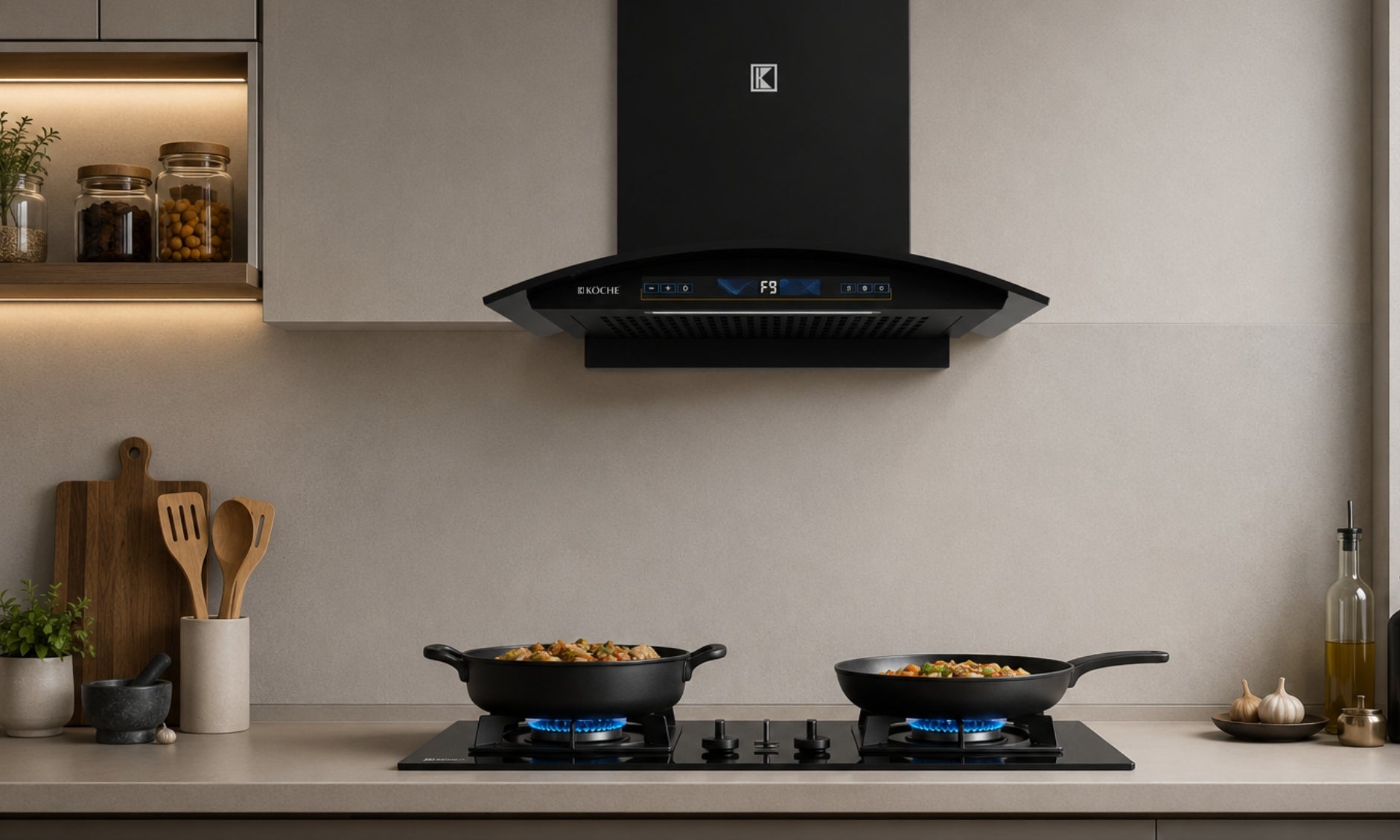
If you've ever stepped out of an Indian kitchen with your clothes smelling of tempering and fried onions, you already know why an electric chimney for kitchen use has become non-negotiable in modern homes. It's no longer a luxury reserved for fancy modular kitchens, it's a practical fix for a very everyday problem: smoke, grease, and odour that linger long after the cooking is done. At Köche, India's first exclusive BLDC chimney brand, this is exactly the problem our entire range is built to solve.
What Is an Electric Chimney?
An electric chimney is a powered kitchen appliance placed above your stove or hob. It uses a motor and fan to pull in smoke, steam, and airborne grease particles, then expel them either outside through a duct or filter them and recirculate cleaner air back into the room.
In a non-electric chimney, there is no need for an electrical connection or motor. It removes smoke and odours from the kitchen naturally through a ducted pipe, without the use of electricity.
How Does Electric Chimney Work?
This is one of the most common questions first-time buyers ask, and the mechanism is simpler than it sounds:
-
Suction: A motor-driven fan creates negative pressure above the cooktop, pulling smoke, steam, and oil particles upward into the hood.
-
Filtration: Depending on the model, the air passes through baffle filters, mesh filters, or a filter-less system that traps grease before it can settle on your walls or cabinets. Every Köche chimney uses a filter-less design, so there's no filter to scrub frequently.
-
Expulsion or recirculation: In ducted models, the filtered air is pushed outside through a duct. In ductless models like the Köche Port 60, the cleaned air is released back into the kitchen.
-
Control: Speed, lighting, and cleaning cycles are managed through a touch panel, gesture sensor, or remote.
The motor driving all of this matters a lot too. Köche chimneys run on BLDC (Brushless DC) motors, which use electronic commutation instead of physical brushes which results in up to 40% more energy efficiency, up to 40% less noise, and roughly twice the lifespan of a conventional motor.
Electric Chimney Design: What's Changed
Early chimneys were bulky metal boxes bolted to the wall. They were functional, but not exactly something you'd want as a kitchen centrepiece. Electric chimney design has moved a long way since then, and Köche's range reflects that shift:
-
Curved glass with gold accents: The Enzo series, built for a refined, everyday look.
-
Slant design with hydraulic louvers: the Laura series, for a more premium, design-led kitchen.
-
Matte black, sleek modular body: the Stark series, for minimalist modern kitchens.
-
L-shaped ducted design: the Bravo 90, built for larger, open-plan kitchens.
-
Ductless, portable design: the Port 60, ideal for apartments and rented homes where ducting isn't possible.
Modern chimney design isn't just about looks. With gesture controls, slim profiles, and auto-clean technology, today's chimneys become a design feature rather than a bulky add-on.
Which Electric Chimney Is Best for India?
This is genuinely the question that matters most, because Indian cooking is tougher on a chimney than most Western cooking styles. Between deep-frying, tempering with mustard seeds and curry leaves, grilling, and heavy spice use, an Indian kitchen produces more smoke, more oil vapour, and stronger odours on a daily basis.
So, which electric chimney is best for India? Look for:
-
High suction power: 1400 m³/hr or higher, rather than the lower ratings common in chimneys designed for lighter Western-style cooking.
-
A BLDC motor: As chimneys are used for at least 2-3 hours on average in Indian kitchens, the motor matters more than you think. BLDC motors use less power and hold up better under daily heavy use than older brushed motors.
-
Auto-clean functionality: Given how much oil Indian cooking generates, a chimney that cleans itself saves significant manual effort.
-
Filter-less or baffle filter designs: Less frequent scrubbing, more consistent suction over time.
-
Size matched to your stove: 60 cm for a 2-burner stove, 75 cm for 3 burners, and 90 cm for larger 4–5 burner cooktops.
How Much Electricity Does a Chimney Motor Consume?
Conventional AC motors typically draw between 200W and 250W (depending on the model), roughly equivalent to the power consumed by 2-3 ceiling fans running simultaneously. Köche's BLDC motors are engineered to consume significantly less power (between 10W and 130W), depending on the fan speed and suction power. As a result, Köche BLDC chimneys are estimated to save up to ₹800 per year on electricity bills compared to older, less efficient models. In practical terms: running a chimney for an hour or two a day, even at higher speeds, adds only a modest amount to your monthly electricity bill.
How to Clean Electric Chimney (Step by Step)
-
If your chimney has an auto-clean mode, use it every 1–2 weeks to remove the grease that accumulates around the motor housing.
This grease is then collected in the oil collector tray, which can be washed and reattached.
-
In case of chimneys with mesh or baffle filter, carefully remove the filter after switching off the chimney.
Soak it in a large tub of hot water and dish soap for 20–30 minutes. This soaking period loosens grease and makes scrubbing more effective.
You can then use a soft-bristled brush to gently scrub the filter surfaces.
-
Wipe the exterior weekly with a soft cloth, lukewarm water, and a mild detergent. Avoid abrasive scrubbers, as they can dull the finish.
-
If you have a ducted model, check the duct occasionally for blockages. Reduced suction is often a sign that the duct needs attention.
-
Avoid harsh chemicals on glass or touch-panel surfaces. Stick to mild glass-cleaning solutions.
-
Book a preventive service twice a year with an authorized Köche service centre for deeper internal cleaning.
How to Fix Electric Chimney Issues
Most common chimney problems have simple explanations before you assume the worst:
-
Weak suction: Usually caused by grease buildup inside the unit or a blocked duct. Run the Heat Auto-Clean cycle and check once.
-
Unusual noise: You can start by switching off the chimney and tightening any loose parts, such as the filters or wall brackets.
If the noise still persists, you may need to lubricate the moving parts or check the external duct pipe for any blockages that could be causing the noise. It is best to have this done by a professional rather than attempting it yourself.
-
Chimney not turning on: Check the power supply and switch first; if it's gesture-controlled, make sure the sensor area is clean and unobstructed.
-
Auto-clean not working: Confirm the chimney is in standby mode and that the auto-clean button is pressed for the full 3 seconds; also check the oil tray is properly seated.
-
Lights not working: Usually a simple LED replacement rather than a wiring issue.
For anything beyond basic cleaning and troubleshooting, it's best to contact Köche's customer care team rather than attempting a motor-level repair yourself.
Frequently Asked Questions
What is the cost of an electric chimney?
The cost of an electric kitchen chimney typically ranges from ₹6,000 to ₹30,000, depending on its size, suction capacity, and features. Basic models start at around ₹6,000, while advanced, filter-less BLDC motor models with features such as auto clean and motion sensors typically cost between ₹12,000 and ₹20,000
How is a BLDC motor better than a traditional electric chimney motor?
A BLDC (Brushless DC) motor uses electronic commutation instead of brushes, removing the friction and wear that shorten a conventional motor's life. This means quieter operation, more consistent suction, lower maintenance, and better long-term durability.
Why should I choose a Köche electric chimney for my kitchen?
Köche electric chimneys run on advanced BLDC motors that are up to 40% more energy-efficient, generate up to 40% less noise, and offer roughly 2x the lifespan of conventional motors. Inspired by German design principles and built for Indian kitchens, they come with Heat Auto-Clean, Gesture Control, 9+1 Turbo Speed, and (on select models) hydraulic louvers or Multi-Suction Technology.
What does electric chimney installation cost?
Standard installation is priced at ₹700, typically completed within 48–72 hours of raising a service request. Core cutting, if required, is charged separately.
Can an electric chimney be installed near tiles or a window?
Yes. Installation on tiled walls is possible with careful handling, and installation near windows is supported too, provided adequate support structure is available. There should be a plug point nearby.
What size should I choose for my electric chimney?
Choose 60 cm for a 2-burner stove, 75 cm for 3–4 burners, and 90 cm for 4–5 burners or a larger, heavier-use kitchen. Wider chimneys offer better coverage and suction for bigger cooking areas.
How do I decide the right suction capacity for my kitchen?
Base your choice on your kitchen size and cooking style. For light, occasional cooking in a small kitchen, a chimney with 600 - 1000 m³/hr suction is usually sufficient. For regular Indian-style cooking involving frying and grilling, choose a chimney with a suction capacity of 1400 m³/hr or higher.
Share:
Kitchen Chimney Replacement Guide: 5 Signs You Shouldn't Ignore
Glass vs Stainless Steel Cooktop: Which Is Better for Your Kitchen?